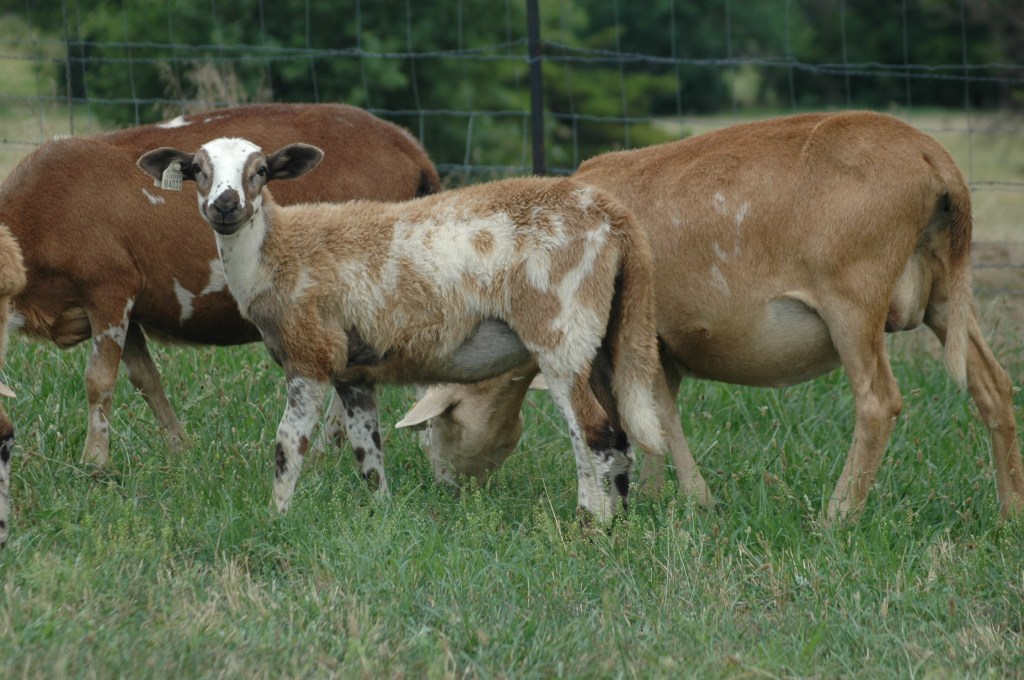
We’ve been raising hair sheep for over 20 years. Initially, we started with Boer meat goats and later Kikos for brush clearing. To better utilize our pasture and tackle noxious weeds that our cows wouldn’t eat, we added Barbados and St. Croix sheep.
Within a few years, our brush was cleared, but our goats became more of a nuisance, constantly seeking fresh brush and struggling with slow growth, internal parasites, and frequent hoof trimming. Despite our efforts to improve them through rigorous culling and breeding, we decided to sell our entire goat herd. We then chose to focus solely on hair sheep and cattle, guided by our philosophy: Adapt, Thrive, Produce… Inspired by Nature.
How we discovered Katahdin sheep
In the early years of our hair sheep venture, we explored all the breeds we could find locally. We loved the hardiness of the Barbados sheep, their vitality at birth, fertility, mothering ability, and excellent hooves. However, their small size, slow growth, and tiny carcass were limiting, and they were quite flighty.
We also tried the Dorper breed, both black-headed and white. We were impressed with their stockiness and rapid growth, but like the Boer goat, they weren’t as fertile as we needed for profitability on range. Additionally, their mothering, shedding, and feet left much to be desired.
The St. Croix were a better option—larger than the Barbados and better in some respects compared to the Dorper. They had good shedding and mothering but were still somewhat small and flighty, and they were hard to find.
Then we met Karen Kenagey from NW Oregon and purchased a Katahdin ram named “Kat.” We were immediately impressed. We found Katahdins to be balanced, fertile, good shedders, parasite resistant, and well-sized to thrive on natural vegetation with minimal supplementation. They were also good mothers and docile, and they came in a variety of colors.
Over time, it became clear that Katahdins just worked better for us. They might not be the biggest, hardiest, or fastest-growing, but they excelled in every category in a balanced way, like the dependable Toyota Camry of sheep. Our approach has been to “cull heavy with no regrets—if it doesn’t advance our goals, it needs to go.”
Over the past decade, we have focused on improving our Katahdin sheep by developing more of a breed that thrives on natural vegetation with minimal inputs. After investing in various bloodlines and culling animals that didn’t fit our low-maintenance, grass-based system, we have worked to create a flock that is both functional and adaptable. Our goal has been to build a better, more practical Katahdin breed that meets the needs of commercial shepherds and small homesteads. Today, we continue to retain and breed the best-performing animals while selling the rest to individuals who seek smaller flocks for meat or enjoyment.
While both of us worked off-farm jobs, we were never focused on becoming purebred sheep producers or selling every animal as purebred. Only about 20% of our ewe lambs and 5% of our ram lambs were considered worthy of registration. Instead of buying the best genetics and feeding them intensively, we chose to focus on breeding a sheep that is capable, functional, and adaptable to various environments. We meticulously tracked records year after year to identify the best producers under a low-input system. Although the journey has been more challenging and lengthy than anticipated, we’re seeing increasing consistency in our flock. Our guiding philosophy is to raise animals that work for us: “Balanced Functional Genetics, Developed and Raised on Pasture.”
We don’t raise pets or show animals; our focus is on producing sheep that work well and deliver quality results. If they don’t meet our standards, they go to freezer camp or another ranch with lower expectations. While we care for our livestock by providing fresh water, grass/hay (in winter), salt, minerals, and sunshine, we expect them to adapt, thrive, and produce regardless of weather conditions.
Our criteria is high: we want sheep that can raise twins after their first lambing, be good mothers, grow at a decent rate, and produce quality meat without needing worming or hoof trimming. They should grow a warm wool coat in winter and shed smoothly in summer, have a moderate herding instinct, and be long-bodied with ample muscling. Rams should be masculine and around 220 lbs at three years, while ewes should be feminine and around 130 lbs. We also seek moderate birthweights under 11 lbs, well-shaped testicles, well-attached udders, good milk production, and consistent performance year after year.
At Inspired by Nature Farms, our top priorities are:
1) Fertility – Our ewes must frequently produce twins. If they don’t make them we can’t sell them, raise them or consume them.
2) Effective mothering – If a ewe can’t raise a lamb to weaning age, it fails to contribute to meat production or market sales. Even if a sheep is visually perfect, it’s only valuable if it has strong mothering instincts, a correct udder, and sufficient milk.
3) Adaptability – We believe in pasture rotation, as each pasture offers different vegetation and minerals, adding variety. We used to involve our flock in vegetation management for fire safety in California, which revealed how well different animals adapted to various conditions. While lush pastures are easier, rugged, rocky landscapes proved challenging, but this helped us improve our herd.
Now in SE Kansas, the environment is drastically different from California’s Mediterranean climate. Our sheep, accustomed to hot, dry summers and mild, wet winters, had to adapt to Kansas’s four seasons, with humid summers and cold, dry winters.
Although the flock is adjusting, the condition they enter winter in is crucial, especially for breeding. We are always refining our supplemental feed program with pasture grass and alfalfa during the cold dry months.
4) Hardiness – They need grit to defend their lambs, stay healthy in adverse weather, and manage summer heat. We want them to flock together so the guard dog can protect them. We rotate pastures to mimic nature but do not use worming treatments; only sheep that can stay healthy and worm-free on their own are kept. We also avoid trimming feet, expecting them to wear down naturally. Our high level of hardiness is attributed to strict culling, free-choice minerals and salt.
5) Longevity – To remain an active member, a sheep must consistently perform well year after year. Ewes that stay over seven years, averaging 180-200% lamb crop, weaning all their lambs annually, and maintaining a Total Ewe Performance (TEP) of 100% or higher are considered elite. They must also be free from worming, hoof trimming, and other issues. Though ewes rarely make it to ten years due to dental wear and difficulty maintaining weight, those that do are highly valued. Rams typically stay 5-6 years as we rotate them annually, maintaining three separate breeding rams.
6) Disposition – As a family farm, our kids are frequently around the animals. Although we never pet rams on their heads or turn our backs on them, we haven’t encountered aggressive Katahdin rams. We value assertiveness in ewes, particularly during lambing; we appreciate it when they show protective behaviors, such as stomping their feet or head-butting when their lambs are weighed and tagged. We’ve seen remarkable maternal instincts. Our sheep are generally docile and peaceful, and by their second year, they’ve learned the routine so well that they almost weigh themselves during inspections.
7) Conformation – is important but not the top priority for us, especially for commercial sheep ranchers focused on yearly lamb production. We emphasize it more in our rams, seeking traits like a great build, stockiness, and masculinity, though we acknowledge imperfections, such as a tail being too long. For ewes, productivity is paramount. While we prefer ewes that are both functional and well-formed, we find that the most productive ewes are generally well-conformed from the start.
We also cull based on birth weight, requiring our breeding stock to be under 11 lbs. Although we used to set a strict limit of 10 lbs, we found that many high-quality lambs fell slightly above this threshold. Our focus is on maintaining moderate birth weights to avoid difficult births and to optimize lamb growth. We value multiple smaller lambs over fewer larger ones for better overall weaning weights. Thus, while conformation is important, it ultimately depends on the breeding goals and context.
In a nutshell, we enjoy our Katahdins for their overall balance and reliability. They may not be perfect, but they are a solid, moderate-sized meat sheep that thrive on minimal inputs year after year. If you’re interested in seeing our flock and exploring what we have to offer, feel free to reach out, and we can arrange a visit. You might find something valuable for your own flock.
 Inspired by Nature Farms